We are often asked about how a racing chair steers.
Clearly they manage to go around the bends of a track without any apparent steering mechanism…well, unlike a bicycle front wheel or traditional wheelchair castor, the racing chair does not rely on any self-centering gyroscopic effect to steer.
So, how do the athletes steer?…in essence, they don’t. All chairs have a mechanism called the track compensator. The mechanism itself varies a little between manufacturers, but they all work in roughly the same way:
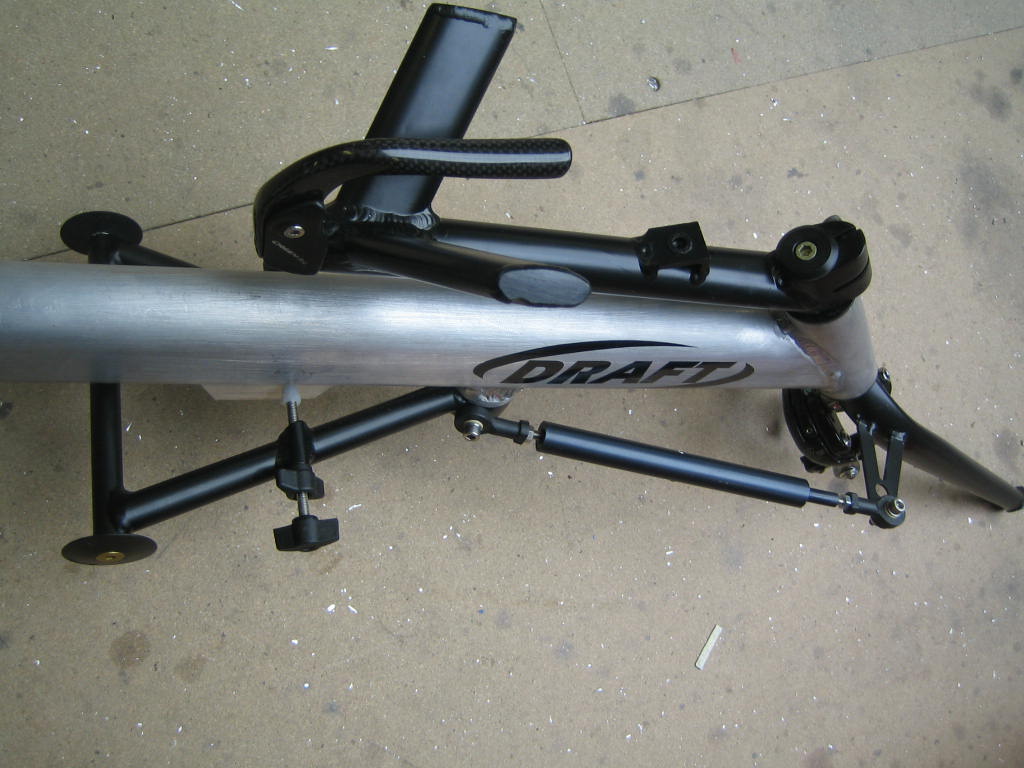
A-frame compensator linked to the front fork via a double-acting spring. Steering handles and brake lever on the top.
On my chairs, there is a push/pull spring unit running from an arm on the RH side of the fork to an a-frame device (the compensator itself) fitted to the underside of the chair.
When the compensator is hit left or right, the front fork is turned a little. On the track, the compensator enables the athlete to only briefly stop pushing 4x per lap. It has a pair of adjuster screws which contact a vertical plate underneath the frame.  The RH adjustment is set so that the chair tracks straight in the lane when the screw contacts the plate. There is a second screw on the left side, which is set for the curvature of the bend of the athlete’s particular lane, or in the case of longer ‘out of lane’ events, generally Lane 2.
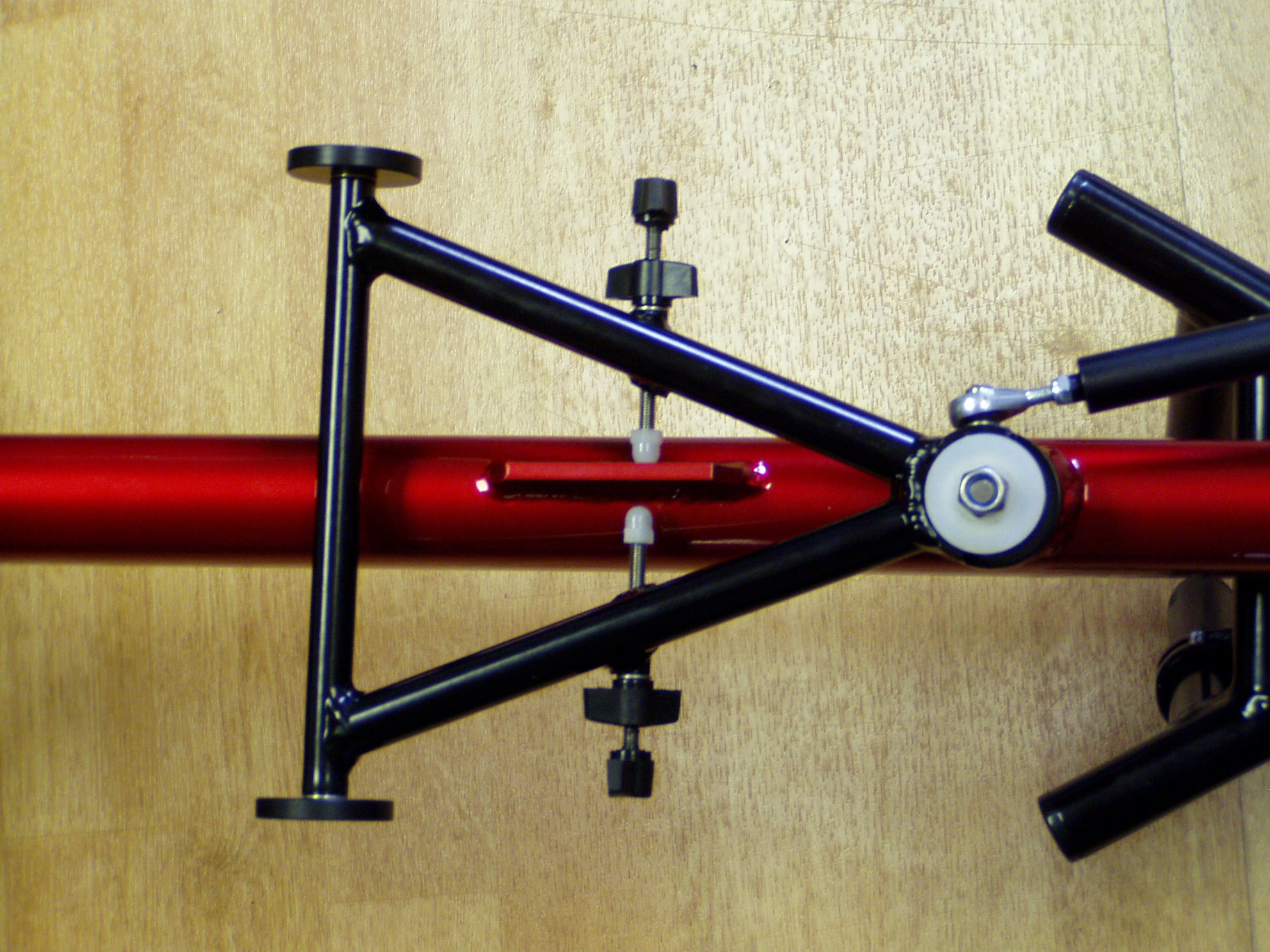
Adjustable screws either side of a welded stop plate on the underside of the frame.
Thus, during the race, the athlete firstly sets the compensator for the straight, then as the front wheel crosses the transition line to the bend, they hit the LH side of the compensator, setting the front wheel to the left, forcing the chair to track around their lane. Once at the transition line back to the straight, the RH side of the compensator is struck, and the chair returns to straight. Clearly timing is crucial in this process and it takes a lot of practice. Athletes are disqualified if they drift out of lane, so they will often use hip or arm movements to lightly nudge or ‘hip’ the front wheel to stay in lane.
The push/pull spring allows the track steering mechanism to be overridden in case of an emergency/crash etc, and is also used to steer around tighter bends during road races using the ‘handlebars’. When steering is released, the mechanism returns to the centre.
If you watch some coverage of racing (I link to this one, as I made Dave Weir’s chair), you will see the athletes stop pushing briefly, tap their compensators, then restart as they cross the transitions into and out of the bends.
I hope that clears things up a little.
Dan Chambers
Draft Wheelchairs Ltd